My favorite memory from last summer was eating chocolate. Not just any chocolate. Tony’s Chocolonely. I was sitting in my Airbnb. Not just any Airbnb. It was a house boat parked on a canal in Amsterdam. My boyfriend and I had spent the night prior on an overnight bus from London, and we spent the day being the epitome of tourists. When the sunset over the canal, we could barely keep our eyes open.
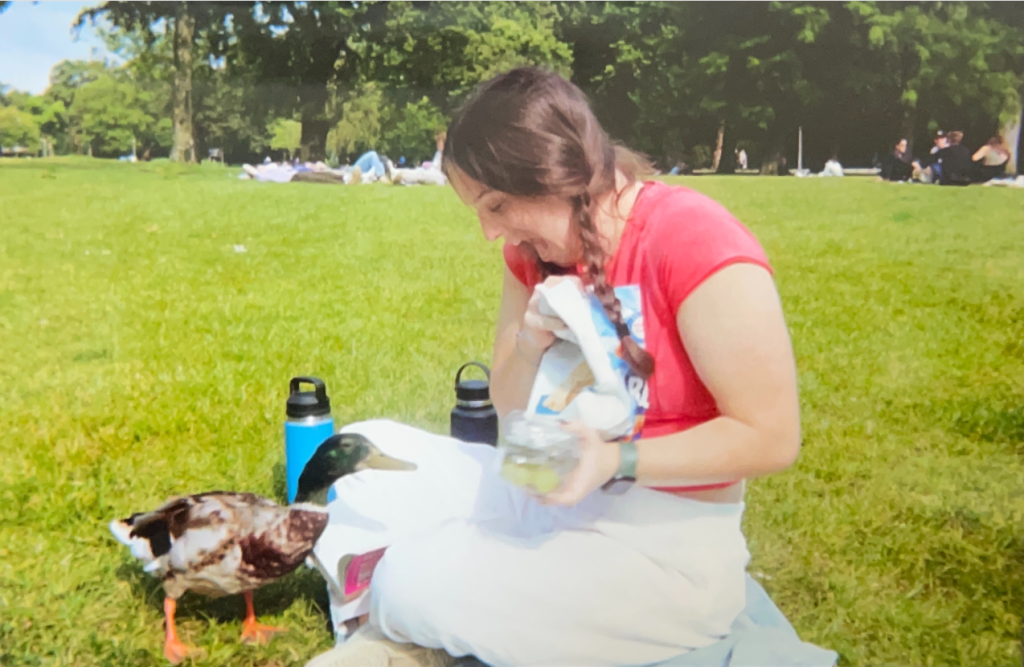
While I tried to shower off the travel, Nathan, my boyfriend, walked to the corner store and started gathering supplies for the picnic we had planned for the next day in Vondelpark. He came back with a chocolate bar I had never seen before, but we knew we couldn’t end the day without trying it. Pictured above you can find me protecting our picnic snacks (including Tony’s Chocolonley) from a local Amsterdam duck.
It was a Tony’s Chocolonely dark chocolate bar. We broke off the uneven pieces, and the rest was history. The chocolate was rich and smooth, but had crunchy pieces of brownie dispersed throughout it. Now, whenever we are shopping in the US and discover a Tony’s Chocolonely bar, a smile appears on our face. It reminds us of that one night in Amsterdam when we sat and digested the life long memories we were making.
When we were enjoying Tony’s Chocolonely in Amsterdam, we had no idea at the time that we discovered the chocolate in its motherland.
Teun van de Keuken is Tony himself and a Dutch TV journalist. In 2003, Keuken discovered that forced labor still existed in the cocoa industry. Him and his fellow journalists decided to take a stand. Keuken took advantage of the Dutch law called “fencing.” This meant that if you knew a product was made illegally and you purchase it, you are also responsible for the crime. Keuken filmed himself eating the chocolate he believed was made with illegal forms of labor and turned himself into the police as chocolate criminal.
After the case was eventually dismissed, Keuken and his crew crafted 5,000 fairtrade and traceable chocolate bars. Tony’s Chocolonely was born.
“Chocolate is one of the happiest products there are, but the realities hidden within the cocoa industry are not so sweet.”
The chocolate company has taken on a mission to end labor exploitation in the chocolate industry. In present day, Tony’s reports a total of 1.56 million cases of illegal child labor and 30,000 cases of forced labor on cocoa farms in West Africa.
To combat this crisis, Tony’s relies on three pillars of action.
Creating awareness
Leading by example
Inspiring other chocolate brands to act
All the farms Tony’ sources cocoa from is covered by the Child Labor Monitoring and Remediation System. CLMRS “identifies instances of child labor, finds alternative solutions and prevents the use of child labor by raising awareness.” The CLRMS works to remove a child from child labor within a period of 6 to 12 months after the case is discovered.
Tony’s communicates it’s mission through the physical shape of the chocolate bar. Every consumer gets a taste of their values and exquisite chocolate.
“It doesn’t make sense for chocolate bars to be divided into equal-sized chunks when there is so much inequality in the chocolate industry!”
These unique shapes are intentional and meant to remind customers that profits in the cocoa industry are unequally divided. The bottom of the bars represent the West African coastline, the chunks above represent the Gulf of Guinea.
Although Tony’s goes above and beyond in their flavors and tastes, their constant strives towards bettering the cocoa industry for all, will always set them apart from your average-joe chocolate.

 Alexandra Gillette
Leave a comment